Dubai workplace trends guide
Hybrid Office Relocation Dubai: How to Design a Flexible Workplace in 2026
Hybrid office relocation Dubai is one of the clearest workplace trends right now. Recent market research from CBRE and JLL points to structured hybrid work becoming the norm, while office leaders increasingly focus on workplace experience, flexible space, and AI-readiness. In Dubai, that means more companies are moving away from fixed desk density and toward smarter, more adaptable workplaces.
This guide is for companies that want to understand the new workplace playbook. Instead of asking how to fit the same office into a different tower, the better question is: how should the new office support the way the business actually works in 2026?
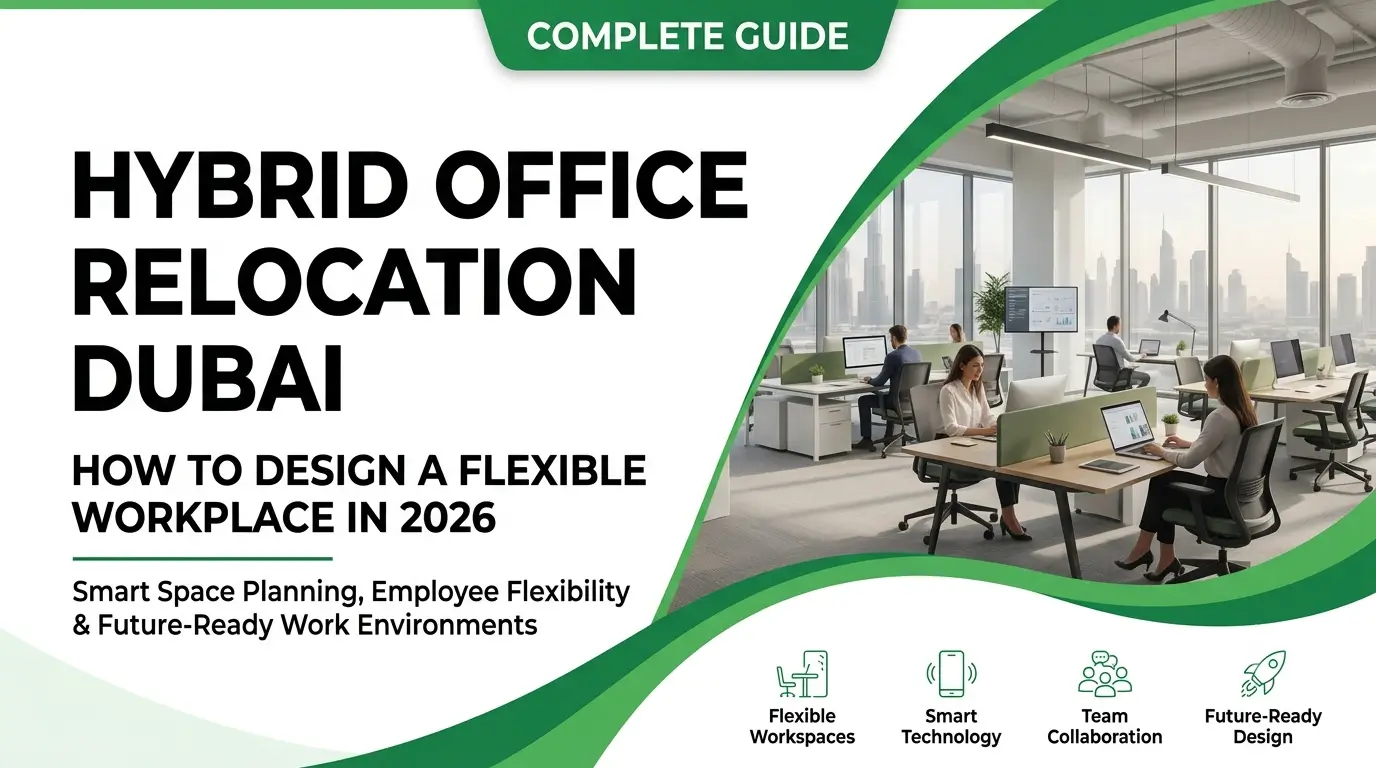
Why Hybrid Office Design Is Trending Now
Hybrid work has matured. Many businesses are no longer debating whether employees can work flexibly. They are deciding how the office should evolve to support collaboration, client meetings, onboarding, and team culture. That shift is why office relocation and office redesign are increasingly linked together.
The modern office is less about maximum occupancy and more about making in-person time valuable. If staff only come in on selected days, those days need better meeting spaces, clearer support systems, and a layout that encourages real collaboration rather than wasted square footage.
Another reason this trend matters is AI-readiness. More companies want offices that support smart booking systems, connected meeting rooms, occupancy visibility, and better workspace data. In other words, the office is becoming more intelligent, not just more stylish.
What a Hybrid-Friendly Office Needs
A hybrid-friendly office is not simply a smaller office. It is a more intentional one. Every zone has a purpose, and the design supports different work modes across the week.
Reception and arrival
First impressions still matter. A hybrid office should have a clear arrival point, good wayfinding, and enough space to handle peak days without feeling crowded.
Shared desks
If the office uses desk booking or hot-desking, the workstation area should be simple, durable, and easy to reset at the end of each day.
Meeting rooms
Hybrid teams need meeting rooms that work well for in-person sessions and video calls. Good acoustics and screen placement are just as important as furniture.
Focus zones
The office should still give staff a place for uninterrupted work. Quiet rooms, booths, or acoustic pods can be more useful than adding extra desks.
Collaboration space
Shared project tables, brainstorming corners, and informal seating help make office days worth the commute.
The most successful hybrid offices usually balance three needs at once: room for collaboration, room for concentration, and room for the technology that connects both. If one of those is missing, the office can look modern but still feel hard to use.
Hybrid Work Features Businesses Are Prioritizing in 2026
Across offices, the trend is moving toward flexible, experience-led environments. The following features are especially common in 2026 workplace planning:
| Trend | Why it matters |
|---|---|
| Desk sharing | Reduces fixed seating and supports fluctuating attendance. |
| Collaboration hubs | Creates shared spaces for team days, workshops, and client meetings. |
| Acoustic privacy | Helps staff focus during busy hybrid weeks and makes video calls easier. |
| AI-ready infrastructure | Supports modern workplace tools, room booking, analytics, and connected meeting rooms. |
| Flexible zoning | Separates quiet work, social space, and meeting areas for better productivity. |
These are not decoration trends. They are response trends. Companies are redesigning because their teams show up differently now, and the office needs to work harder on the days people actually come in.
How Dubai Companies Can Plan a Hybrid Move
If your company is relocating in Dubai, hybrid planning should start before fit-out decisions are made. That means understanding attendance patterns, collaboration needs, and the type of work your teams do on site versus remotely.
1) Map attendance patterns first
Before you pick desks or meeting rooms, understand how many people are expected in the office on a normal day, on a peak day, and on a light day. This tells you whether the workplace needs more collaboration space, more shared desks, or more quiet zones.
2) Define which tasks need to happen in person
Some businesses use the office for client meetings, workshops, onboarding, leadership sessions, or team-building. Others need secure, always-connected workstations. The answer changes the layout. A hybrid office should support the work that benefits most from in-person time, not just provide seats.
3) Design for movement, not just density
When fewer people are in the office every day, circulation, informal meeting points, and quick collaboration areas become more important. Space that was once used for fixed desks can often become a better mix of project tables, shared resources, and quiet pods.
4) Align the office with technology
Hybrid offices work best when booking, video conferencing, and connectivity are simple. Good technology reduces friction and makes the office more usable for both staff and visitors. This is one reason AI-ready workplace planning is now part of the relocation conversation.
5) Keep the employee experience in mind
If the office feels cluttered, noisy, or inconvenient, hybrid attendance suffers. The goal is not just to have a workplace; it is to have one people actually want to use. That is a design problem as much as a real estate problem.
Dubai Districts Where Hybrid Office Planning Matters Most
Location still matters, but the right question is no longer only "How do we move here?" It is "How does this district help us run a flexible workplace?"
Business Bay
Business Bay is often suitable for hybrid workplaces because it has a mix of modern towers and central-city access, but the office layout still needs to be planned around real attendance patterns.
DIFC
DIFC works well for premium client-facing hybrid offices where presentation, meeting quality, and controlled access matter.
Downtown Dubai
Downtown Dubai is a strong fit for companies that want a high-profile address and spaces that support client meetings and executive collaboration.
Dubai Marina
Dubai Marina can appeal to teams that want a lifestyle-oriented location, especially if the office is being redesigned around flexible attendance.
JLT
JLT is often practical for companies moving into a more flexible workplace model because it can support a range of office sizes and tenant types.
Dubai Internet City
Dubai Internet City is especially relevant for technology-led firms that need hybrid-ready offices with strong connectivity and collaborative digital workflows.
Practical Steps for a Flexible Workplace Relocation
A hybrid office move is easier when the relocation project and the workplace strategy are handled together. The following sequence helps keep both aligned:
- Review the current office and identify what no longer fits hybrid work.
- Decide how many desks, rooms, and collaboration areas the new workplace needs.
- Document the technology requirements for meetings, booking, and connectivity.
- Work out whether the office should feel more client-facing, more collaborative, or more focused.
- Translate the strategy into a move scope, fit-out brief, and handover checklist.
- Use the relocation estimator to compare scenarios before you brief vendors.
For planning teams, this is where a structured approach matters. The office should not be designed around old habits. It should be designed around how the business will actually use the space over the next 12 to 24 months.
How a Planning Tool Helps with Hybrid Office Moves
Even though this article is about workplace design rather than cost, a planning tool still helps. It lets teams compare office size assumptions, relocation scenarios, and service scopes before they commit to a layout or an occupancy model.
That matters because hybrid offices often create new questions:
- Should the office have fewer fixed desks and more shared work points?
- How much collaboration space does the team actually use?
- Do we need a quieter office or a more social one?
- Which layout better supports our attendance patterns?
- How much does the relocation scope change if the office is redesigned for hybrid work?
The Office Move Estimator calculator is useful here because it helps teams compare scenarios before they ask contractors or movers to quote. That gives leadership a clearer picture of which office model is realistic.
Use the Calculator to Test Workplace Scenarios
Office Move Estimator can help businesses compare different relocation scenarios, space assumptions, and office setups before they commit to a hybrid workplace strategy. That is especially useful when the company is deciding whether to shrink, reconfigure, or simply redesign its current footprint.
If you are planning a move in Business Bay, DIFC, Downtown Dubai, Dubai Marina, JLT, or Dubai Internet City, the calculator can help you think through the implications of each option before you start the relocation process.
Frequently Asked Questions
What is a hybrid office?
A hybrid office is a workplace designed for a mix of in-office collaboration and remote work. It usually includes fewer fixed desks, more meeting zones, better collaboration spaces, and technology that supports flexible attendance patterns.
Why is hybrid office design trending in 2026?
Hybrid work has become a stable operating model for many companies, so offices are being redesigned to support collaboration, focus work, and flexible occupancy rather than maximum desk density. Current market research also shows a stronger focus on workplace experience and AI-readiness.
What features make a workplace hybrid-friendly?
A hybrid-friendly workplace usually has hot desks, bookable meeting rooms, acoustic areas, strong Wi-Fi, good video conferencing, storage for shared equipment, and layouts that support both quiet work and team collaboration.
Which Dubai districts suit hybrid office planning?
Business Bay, DIFC, Downtown Dubai, Dubai Marina, JLT, and Dubai Internet City can all work well for hybrid offices, but each district has different building access rules, office formats, and tenant expectations that affect the final layout.
Does hybrid office planning reduce the need for space?
Often yes. Many companies use hybrid planning to reduce their total footprint or make better use of the same area. The exact result depends on attendance patterns, team structure, and how much collaboration space the business needs.
What is the role of technology in a hybrid office?
Technology is central to hybrid offices. Video conferencing, booking systems, secure Wi-Fi, collaboration tools, and good AV setup help in-office and remote staff work together without friction.
How can a planning tool help with a hybrid office move?
A planning tool helps companies compare scenarios, estimate the scope of the move, and think through how different layout choices affect the relocation. That makes it easier to brief designers, facilities teams, and movers with a consistent plan.
Is hybrid office relocation only for large companies?
No. Startups, SMEs, and larger enterprises all use hybrid planning. Smaller teams may simply need fewer desks and more flexible meeting space, while larger organizations often use hybrid planning to optimize multiple departments at once.
Conclusion
Hybrid work is no longer a temporary adjustment. It is a current workplace model, and Dubai companies are increasingly using office moves to redesign around it. The strongest workplace strategies now focus on flexibility, collaboration, acoustic comfort, and technology readiness rather than just adding more desks.
If you are planning a new workplace in Dubai, the most useful next step is to define how your team actually works and then shape the office around that pattern. Whether you are in Business Bay, DIFC, Downtown Dubai, Dubai Marina, JLT, or Dubai Internet City, the best office is the one that makes hybrid work easier rather than more complicated.
Use the Office Move Estimator calculator to compare workspace scenarios before you finalize your next office plan.